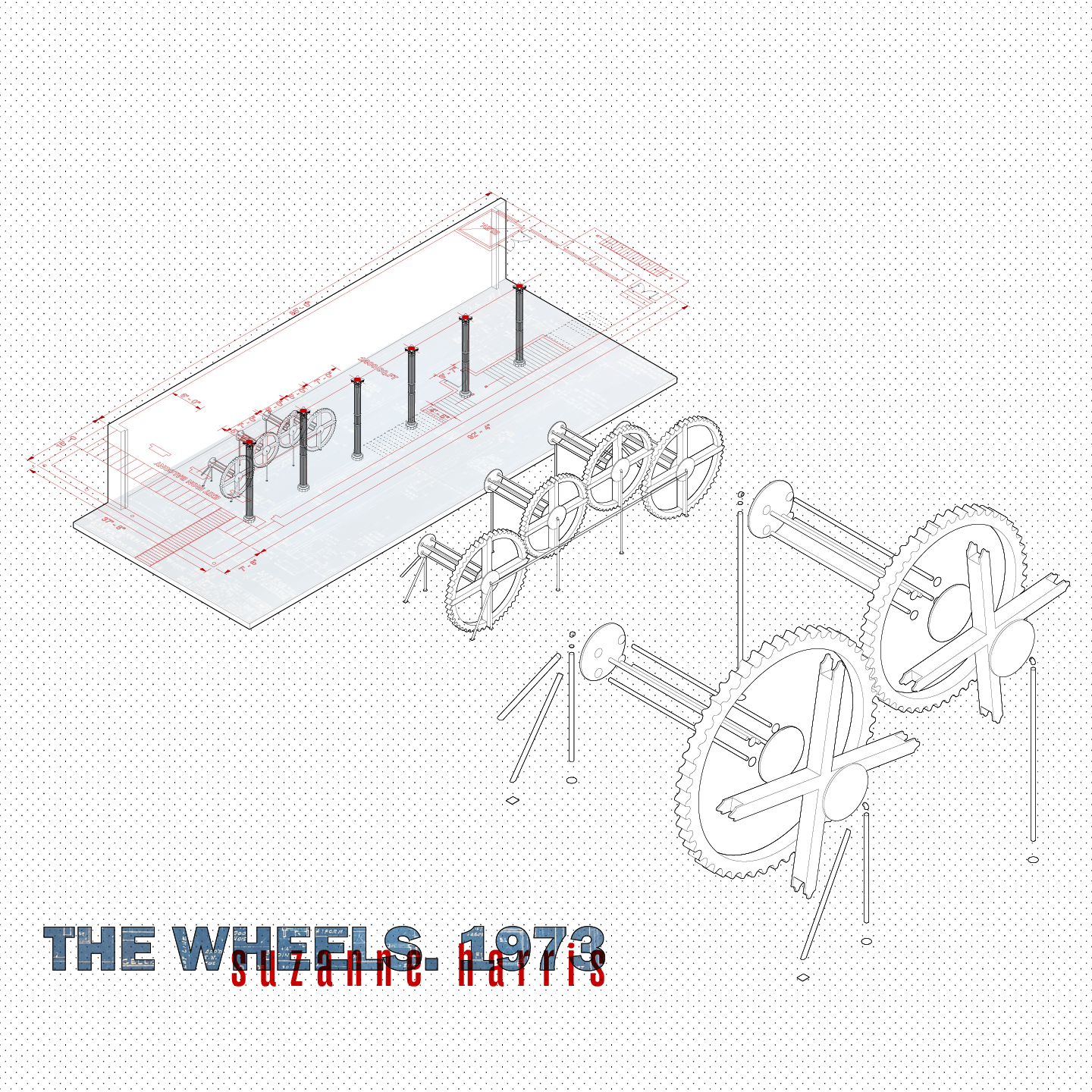
INSTRUCTIONS FOR USE The Wheels Suzanne Harris, 1975, 112 Greene Street, New York City
Suzanne Harris’s The Wheels (1975) is an experiment in kinetic architecture, where the body is an active participant in in its system of interdependent movement. Constructed from reclaimed timber and laminated wooden gears sourced from defunct industrial sites in Soho, the work operates as a mechanism for , transforming the architectural space of the loft into a site of movement, embodiment and inquiry. The work can be understood as a choreographic mechanism that prompts collective negotiation, a coordination of bodies and mechanical systems that move and are moved by one another. What follows is a list of poetic "instructions for use" that describe the way in which user(s) are prompted to move through the constructed system, or more specifically the way in which the system invites certain types of movement and coordination.
1. Approach & Gather Find a trajectory, a vector, a path, a TOWARD. Approaching is a gathering, an orientation of bodies, objects and landscapes. Approaching is anticipation. The body feels the movement, shape, dimension, even before it reaches it. It gathers the body, the potential of the interlocking gears. Observe. The gears are still, but they carry the memory of prior movement. Trace the arc of their potential rotation, worn wooden edges smoothed by past hands and bodies. Feel the latent tension in the teeth of the wooden gears. The gear does not move yet, but it is listening—waiting for pressure, for weight, for the commitment of movement.
2. Unground- Shift your weight forward. The first motion is slow, a resisting, a friction. The space around you tilts as the structure responds. You are no longer in static relation to the ground; your axis of movement is changing. Lean into the motion. Gravity pulls at you, but you determine the speed. Find the rhythm between force and control, motion and pause. Notice the recalibration of your equilibrium as the gear rolls forward. The loft floor beneath you is no longer a fixed plane but a shifting horizon.
3. Assembly & Attunement Feel the system at work. Your movement is not isolated—it transfers into the framework, through the gears, into the weight of others. Every lean, every shift in balance, every pause affects the whole. You are part of a kinetic network. Coordinate systems. The wheels move each other, a system of linked motion. Listen with your body to the momentum of your fellow participants. The system will not function without collective presence.
4. Rooting + Routing Test resistance and release. Slow down. Try to stop. Observe how your own movement lingers in the system, the way momentum continues even as you pause. Let another body take control. Re-enter at a different angle, creating another route through it, alternating weight distribution, and feel how the work adapts. Disrupt the forward momentum. Shift direction. Press against the grain of the movement. What does reversal feel like? How does the system react when tension is applied unevenly? The wheels are not merely objects but instruments of negotiation, adjusting to force, unpredictability, and variation.
5. Exiting & Residual Motion Step out, but do not assume stillness. The wheels are still in motion. Your body has left the structure, but your impact remains—a delayed ripple, a slowed rotation, a memory of weight and inertia still carried in the gears. Look back. The work is not over. The wheels will keep turning until equilibrium is lost.
How has the system been changed by you? And how have you, in turn, been changed by this system?